August 8 2015

9 things I like about Credobaptism (as a pedobaptist)

Bapt-img1

One of the things I am convinced about in the credo/pedobaptist debate is that neither side is clear cut. As R.C. Sproul stated in his debate with John Macarthur on this topic:

“In the absence of explicit teaching, both sides in this controversy are forced to rely upon inferences drawn from what IS explicit in Scripture, and that should – by the very virtue of that fact – force us to go the second mile in patience with one another when we recognise I can not prove to John Macarthur that Scripture commands the baptism of infants and by not baptising infants he is being disobedient to his Lord, and at the same time, he can’t point to a text in the bible that explicitly prohibits infant baptism and say to you ‘R.C. you have to stop doing what Scripture prohibits’. I think we all understand the absence of the explicit directives in either case, and since we are both relying upon inferences, we have to be exceedingly patient and charitable with each other.”

After a lot of time, reading, reflection, prayer and discussion, I think I agree with R.C. Sproul, both on his position that infant baptism is ok, but also on his position that both sides have good arguments. Because of these arguments, I have flipped and flopped on this issue for years, and if you have done your own thinking on this issue and have come out a credobaptist, I wouldn’t blame you for it. My best friend since childhood, Daniel Farrugia has a similar spiritual journey to me. We were both brought up in the Catholic Church and were baptised as infants, we both responded to the gospel in our teens and we both have continued to grow in our faith and become passionate followers of Christ and active members of our respective churches. Daniel ended up in a Baptist church and is settled as a credobaptist, and I ended up in a Presbyterian church and am settled as a pedobaptist. I’m not sure if there is any “chicken and the egg” thing happening there with the denomination and the position, but in any case, we both love the gospel and yet will make different choices in regard to whether we baptise our kids.

In the vein of generosity that R.C. was encouraging, I thought I would list the 8 things that have at different times convinced me of the credobaptist position. These are things that I really, really like about credobaptism. Even though I have come down off the fence as a pedobaptist, I have not come down as a militant one. I admit I could be wrong. And the following are the points that mean I will always respect and even defend credobaptism as a valid position to take. They haven’t been enough to convince me, but if they convince you, I would not hold it against you.


9 things I really, really like about the credobaptist position (even though I am ok with infant baptism)
:

1. SIMPLICITY
It’s simple. It tries to just read the text as it stands and obey it sincerely. The argument goes like this: “Peter said, repent and be baptised and you will receive…” (Acts 2:38). That’s the order, why mess with it? It’s not a very deep or sophisticated argument, but that to me is actually its strength. Some pedobaptists can argue in a way that makes you feel like you need a Masters of Divinity specialising in covenantal theology before you can wrap your head around their position. The best of the credobaptist arguments are the simplest. Infant baptism isn’t taught, so let’s not do it. Repent and be baptised is taught, so let’s do that. I really like that simplicity.

2. CENSUS
It aims to ensure that no one can call themselves a Christian falsely. Nominal and cultural Christianity are a really big issue. There are millions of people around the world that would tick “Christian” on the census form and yet when they meet Jesus one day, they will say, “Lord, Lord” but he will say, “I never knew you.” (Matthew 7:21-23). Part of the problem is that we are too quick to call someone a “Christian” simply because they assume that title. I think wanting it to be clear who is and isn’t a Christian is a good thing and purifying our churches from “census” Christians is a noble goal. Credobaptism aims to only baptise those who have consciously and publicly agreed to and embraced the gospel, and this comes from a godly desire to protect individuals, the church community, and the reputation of the gospel itself. I admire and agree with those goals.

3. EVANGELISM
It’s evangelistic. Everyone, including the children brought up by believing parents, is called to repent and put their trust in Christ. The call goes out to all and everyone is expected to respond individually. This tries to avoid any feelings of privilege that someone may feel because they grew up in a Christian household. John the Baptist addresses a similar issue with the Jews who were coming out to be baptised: Bear fruits in keeping with repentance. And do not begin to say to yourselves, ‘We have Abraham as our father.’ For I tell you, God is able from these stones to raise up children for Abraham.” (Luke 3:8). John didn’t allow them to rest on the fact that they were brought up with a certain faith. They had to repent and respond, just like everyone else. Many credobaptists have the same fiery, evangelistic drive as they encourage their kids, when they’re ready, to respond to the gospel with, repentance, faith, a public profession and with baptism. I like that fieriness.

4. EXPERIENCE
It creates a memorable experience for every Christian. This point sounds silly, but it used to be one of the biggest reasons why I agreed with credobaptism for a long time. Think about it, there aren’t many “once off” rituals in the bible. In the Old Testament, the sacrifices were done every day. In the New Testament, the Lord’s Supper is done whenever Christians gathered. These rituals kids could watch and grow to understand over time. But there are some rituals that happen once. Circumcision and baptism are examples of this. Now, pedobaptists often compare these two rituals to show how it is ok that they are performed on children, but baptism has a significant disadvantage. With circumcision, the Jewish guy could look down every morning and be reminded that he was circumcised. With baptism, the experience comes and then goes, with no ongoing objective reminder that it has taken place. The feeling of the water washing over your body as a reminder of your sins being washed away is only ongoing if it can be remembered. Nowadays, pedobaptists can solve that problem by recording infant baptisms so that they can be watched later, but that seems a poor comparison to actually being able to remember the experience personally. Like having a cut foreskin, or killing a lamb, or eating bread and drinking wine, baptism is a very physically tactile experience. It seems like the nature of the ritual of baptism lends itself to being performed on those that can remember it. Of course, this is more of a practical argument than a biblical one, but it’s still pretty impressive to me.

5. PAUL
It makes reading Paul writings about baptism easier. When Paul writes, “For as many of you as were baptised into Christ have put on Christ.” (Galatians 3:27), and “Do you not know that all of us who have been baptised into Christ Jesus were baptised into his death? We were buried therefore with him by baptism into death, in order that, just as Christ was raised from the dead by the glory of the Father, we too might walk in newness of life.” (Romans 6:3-4), he makes strong connections between his audience’s baptism and their salvation. Pedobaptists would point out that this is because he was writing to first generation Christians who were baptised at the moment of their conversion and so that connection is appropriate, and that if he was writing a few decades later, he might have written differently with a more mixed audience. Whether or not that is true, it still remains difficult for pedobaptists who are raising their kids to read the Scriptures. What will I say to my daughter when she reads Paul making such a connection between baptism and salvation? When she reads that “all of us who have been baptised into Christ Jesus were baptised into his death” how is that true for her? Do I think her infant baptism saves her? Not at all! So how should she read those passages? Now, I’m not saying that there is no answer to these questions. I just like how credobaptism seems to avoid having to answer them.

6. HERESY
It aims to avoid the heresy of baptismal regeneration. Baptismal regeneration is the teaching that the act of baptism is a holy sacrament that actually saves the person who it is performed on. The Catholic Church holds this view, teaching: “Holy Baptism is the basis of the whole Christian life, the gateway to life in the Spirit and the door which gives access to the other sacraments. Through Baptism we are freed from sin and reborn as sons of God; we become members of Christ, are incorporated into the Church and made sharers in her mission: Baptism is the sacrament of regeneration through water in the word.” (Catholic Catechism). This is, pure and simple, a very unbiblical lie and it is one of the biggest heresies that the Catholic Church teaches. Unfortunately, when the general non-Christian world thinks of infant baptism, they generally think of the Catholic understanding of it. For example, there is a presumption amongst some of my work colleagues that my wife & I are getting our daughter baptised as a sort of spiritual insurance policy. That is not the case. I do not think there is anything magical or special about the water of baptism. It is not blessed and the act of getting wet by it will not make one bit of spiritual difference by itself. Of course, I believe that about any adult baptisms as well. The only thing that saves a person is the atoning sacrifice of Christ which is applied to a person when they respond to it in faith. At my daughter’s baptism, I’m sure my minister will go to lengths to explain this so that no one will presume that we believe in the false teaching of baptismal regeneration. The very fact that we have to do that though, is sad and annoying. Now, there are those who believe baptismal regeneration in the credobaptist camp, but by strongly linking baptism with a profession of faith, most credobaptist churches try to avoid anyone being able to make this presumption.

7. DON CARSON
Some of my favourite US preachers are credobaptists. Now this may seem like a silly argument, but hey, we’re getting to the end of the list! I have a great admiration for the passion of John Piper and the sharp teaching of Matt Chandler and the brilliant scholarship of Don Carson, and they are all credobaptists. Now, I don’t want to give in to idol worship, but that’s impressive to me. Especially Don Carson, who many would agree, is one of the greatest biblical scholars in the world. The problem is, there are also heaps of awesome Christian teachers, like R.C Sproul and Tim Keller and even my own minister, Neil Chambers, who have also done their homework and have reached a pedobaptist position. I guess this argument doesn’t convince me either way, but it does give me a sense of humility and generosity when it comes to this debate and engaging with people on either side of it.

8. COOL
There is a part of me that wishes I had been encouraged to get baptised when I became a Christian at aged 16. Unlike every Christian, I do have a clear moment when the scales fell from my eyes and God opened my heart to the gospel and I also have a clear moment when I repented and responded to Christ and the difference for me before and after that moment was as dramatic as night and day. It would have been very cool to have an experience like the Ethiopian eunuch in Acts 8:36 who said, “See, here is water! What prevents me from being baptised?”. Or it would have been cool to have a big event at church or down at the beach where I shared my testimony and invited all my friends along. In the end, after about 7 years of being a Christian, my minister allowed me to choose whether I wanted to get baptised or whether I wanted to embrace my infant baptism. I decided the latter. Although, I know my infant baptism was done in the Catholic Church and so was probably surrounded by false teachings about baptismal regeneration, that simple ritual has a symbol that is far greater than the understanding of the people who were present. The baptism symbolised the washing off of my sins, which, in God’s sovereignty and mercy to me, became a reality in my life 16 years later. So, I am very happy to say that I was baptised as an infant, because it powerfully points to God’s amazing work in my life. Having said that, an adult baptism at the beach would have been cool.

9. IN COMMON
Credobaptists generally have a love for the bible and the message of the gospel of Christ. Credobaptist churches have their problems, and some of those problems are due to their position on baptism, but pedobaptist churches have their problems based on their position on baptism as well. The key I think, is to look at which churches are being faithful to the bible, which churches are loving, which churches are gospel-focussed and which churches are concerned with the things that God is concerned with. When I have that criteria, I find both credobaptist and pedobaptist churches. I’m not saying this debate is not important. It is, and every Christian should think about it and come to some position of conviction (if only when they have their own children and then have to decide), but even though it is important, it is not of first importance (1 Corinthians 15:3-8). The bible is very clear on many issues, but the fact is, the bible is not clear on this issue. At least not explicitly clear. So, as R.C Sproul says, since we are both relying upon inferences, we have to be exceedingly patient and charitable with each other.” Both sides have their strengths and dangers, and we should encourage each other to build on the strengths and be wary of the dangers. Many credobaptists are godly, gospel-focussed followers of Christ. Heck, two of the three guys I had as my groomsmen were credobaptists, and the third one was a Presbyterian minister so he didn’t stand a chance to be anything other than a pedo (sorry Cam, but it’s true). All in all, I admire credobaptism and many of the credobaptists that believe it. We have much more in common that in conflict.

So that’s my list!

I hope if you came to this as a pedobaptist who thinks that credobaptism position has no good arguments, that you have been given a few things to chew over to at least earn your respect for the position.

If you came to this as a credobaptist, you might be filled with renewed confidence in your position and instead be wanting to ask me the question that a friend did recently: “If you have so many good things to say about credobaptism then why are you opting for infant baptism?”

That’s a great question and the answer is in the fact that although this is a list of the things I really like about credobaptism, I could have also written a listen of the things I don’t like about credobaptism or a list of all the things I do like about pedobaptism. I can acknowledge valid and weighty arguments, without having to feel they are enough to win me over. I do think there are weaknesses with the credobaptist position. I even think there are weaknesses with a few of the points I have made in this blog post. But there are also weaknesses in the pedobaptist position. I guess I just feel at the end of the day, pedobaptism has stronger strengths and less weaknesses. But the exploration of that are for a different article.

(edit: I have now written that article explaining my defense of pedobaptism in detail. You can read it HERE)

If you are a credobaptist and you feel I have poorly or unfairly represented the arguments in this article, please do tell me in the comments below. I do not want to be accused of creating a “straw man” for my own benefit.

My main challenge is for all of us to do what I have done here with the ideas that you disagree with, but still respect. Acknowledge their good points. Defend them even! And may we all try to be exceedingly patient and charitable with each other.”


(3180)

Share Button
July 21 2015

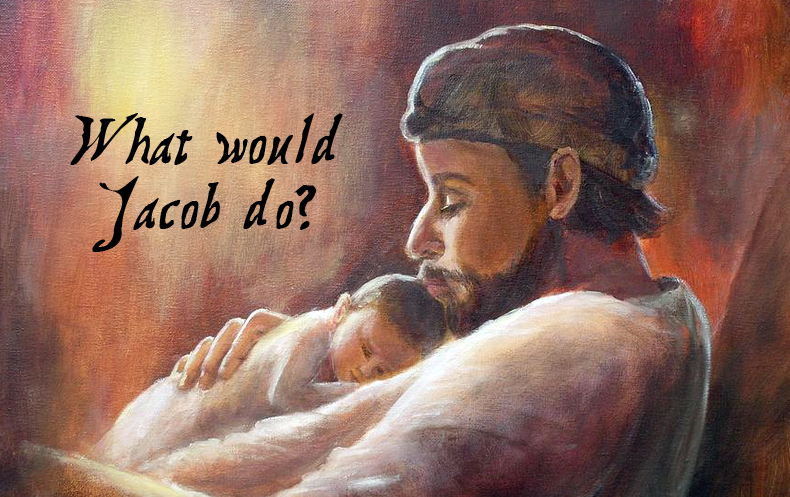
What would Jacob do? (a story to think about baptism)

what would jacob do

There is a long and beautiful biblical tradition of exploring ideas through stories. From Samuel’s “you are the man” hypothetical that he uses to confront King David in 2 Samuel 12, to the parables of Jesus, stories have always been used to draw people in and help them think about how spiritual beliefs might play out in the real world.

This is a story I have written to try to explore how I think about baptism and whether or not Christians should baptise their kids. The question that is left hanging at the end will answer for me whether I sit more comfortably in the credobaptist or pedobaptist position. It may or may not help you also if you are thinking through this issue. Either way, I hope you like it.


WHAT WOULD JACOB DO?

Jacob loved and followed Yahweh, the God of his ancestors, all the days of his life. His parents poured the scriptures into his heart from the moment they held him in their arms. He can not remember a time that he had not had the promises of God, the stories of God’s great works and the songs of the psalms filling his ears and mind. He knew the prophets as well, and longed for the day that the promised Messiah would come to establish God’s kingdom and bring the great shalom that this world so desperately needed.

Now in his late 20s, Jacob was a father himself. Sadly, his wife had died giving birth to their first daughter Mariah, but Jacob had promised her that he would pour the scriptures into the heart of their daughter in the same way that it had been poured into him. As Jacob has learnt from Deuteronomy, Yahweh wanted him to do just that… “Fix these words of mine in your hearts and minds; tie them as symbols on your hands and bind them on your foreheads. Teach them to your children, talking about them when you sit at home and when you walk along the road, when you lie down and when you get up.” (Deuteronomy 11:18-19)

And so that is what Jacob did. Every day, he sang to Mariah the psalms he knew, told her the stories of God’s great acts of salvation and reminded her of the promise that God’s Messiah would one day be sent and that they should be ready. “Yahweh has made a promise, little Mariah,” he would say to her. “And when our Lord makes a promise, he never breaks it. You will see. The Messiah will come and make all things right again and like our father David, we will dwell in the house of the Lord forever.”

—————————–

Now, Jacob lived with his daughter in a fairly isolated village and although he had relatives in Jerusalem, he rarely visited them. Consequently, he knew little of the great events that had taken place there only a few weeks earlier. Over the last couple of years, he had heard rumours about the Nazarene man, Jesus, and his claims to be the Messiah, but he had never seen him and so didn’t give him too much thought. There had been people claiming to be the Messiah before Jesus and there were sure to be ones after as well. Also, the latest rumours were that this Jesus had now been arrested and killed by the authorities for being a trouble-maker and so any hopes that God’s promises were now being fulfilled were put to rest in Jacob’s mind.

As Mariah had been sick, Jacob had not been able to travel to Jerusalem to celebrate the Passover meal with his relatives there. Fortunately now she was better and so he decided to make the belated journey for the feast of Shavuot.

Jerusalem Via Dolorosa1 Crucify ChristAs he travelled through Jerusalem, with Mariah strapped to his back, he marvelled at the crowds of people from all walks of life. The sounds of different languages buying, selling and trading, the interesting colours of clothing and the smells of food and animals were an exciting feast for the senses.

He had not gotten too far, when suddenly out of nowhere, the sound of a great wind came racing through the streets. It started off as a whispering breeze, but eventually thundered as a gale that raced past the crowds of people and disappeared around a building. Everyone ducked to the ground and Jacob reached for his daughter to shield her from the roar of the tempest. After it had gone, everyone stood up slowly, stunned and confused as to what had just happened. People began talking amongst themselves and it didn’t take long for people to follow where the wind had gone. The trickle of curious people became a river as the crowd moved down the dusty road, everyone chatting away in their own tongue about what it could mean. Was there a dust storm on its way? Why did the wind travel in such a curious manner? Where was it going? And is it crazy to even think that wind could be “going” anywhere?

Jacob checked that his daughter Mariah was ok before joining the swarm of people as it moved down the street, following the path of the wind. As they turned the corner, Jacob could hear people shouting praises to Yahweh and speaking of the Nazarene Jesus. This confused Jacob as he thought all interest in Jesus was as dead and buried as Jesus was himself, but what was even more confusing was the discussion that began to spread through the crowd. Somehow, it seemed, everyone could understand what these men were saying as if they were speaking in their own language! Amazed and bewildered, the crowd started to realise that something supernatural was happening. A stranger, standing next to Jacob looked at him and said, “What does this mean?” “I don’t know.” Jacob replied, “But the Spirit of Yahweh is at work here!”
As he said this, a couple of sceptical men stood up on a cart and began making fun of the men who were praising God. “Ahh, stop your crazy yelling!” they hollered mockingly, and then turning to the crowd they said, “Let’s get out of here. These men are clearly just drunk.”

Then one of the men who had been praising God motioned for his friends to stop. He climbed up on a ledge so that he could address the crowd. “Fellow Jews” he began, “and all of you who live in Jerusalem, let me explain this to you… listen carefully to what I say.”

His voice boomed with a sense of earnestness and strength, and Jacob hushed those who stood near him so that he could hear what the man was about to say…

—————————–

“These people are not drunk, as you suppose. It’s only nine in the morning! No, this is what was spoken by the prophet Joel: ‘In the last days, God says, I will pour out my Spirit on all people. Your sons and daughters will prophesy, your young men will see visions, your old men will dream dreams. Even on my servants, both men and women, I will pour out my Spirit in those days, and they will prophesy. I will show wonders in the heavens above and signs on the earth below, blood and fire and billows of smoke. The sun will be turned to darkness and the moon to blood before the coming of the great and glorious day of Yahweh. And everyone who calls on the name of the Lord will be saved.’

 “Fellow Israelites, listen to this: Jesus of Nazareth was a man accredited by God to you by miracles, wonders and signs, which God did among you through him, as you yourselves know. This man was handed over to you by God’s deliberate plan and foreknowledge; and you, with the help of wicked men, put him to death by nailing him to the cross. But God raised him from the dead, freeing him from the agony of death, because it was impossible for death to keep its hold on him. David said about him: ‘I saw the Lord always before me. Because he is at my right hand, I will not be shaken. Therefore my heart is glad and my tongue rejoices; my body also will rest in hope, because you will not abandon me to the realm of the dead, you will not let your holy one see decay. You have made known to me the paths of life; you will fill me with joy in your presence.’

“Fellow Israelites, I can tell you confidently that the patriarch David died and was buried, and his tomb is here to this day. But he was a prophet and knew that God had promised him on oath that he would place one of his descendants on his throne. Seeing what was to come, he spoke of the resurrection of the Messiah, that he was not abandoned to the realm of the dead, nor did his body see decay. God has raised this Jesus to life, and we are all witnesses of it. Exalted to the right hand of God, he has received from the Father the promised Holy Spirit and has poured out what you now see and hear. For David did not ascend to heaven, and yet he said, ‘The Lord said to my Lord: “Sit at my right hand until I make your enemies a footstool for your feet.”’

“Therefore let all Israel be assured of this: God has made this Jesus, whom you crucified, both Lord and Messiah!”

—————————–

This last word, “Messiah”, rang out and echoed across the crowd as everyone stood in stunned silence. For Jacob, this word cut straight through to his heart and rested there like a seed falling on good soil. God opened Jacob’s heart so that he could receive this word and all at once Jacob knew it was true.

“Mariah! Mariah!” he cried, taking his daughter out of her sling and holding her up to his beaming face, “Jesus is the Messiah! Jesus is the Messiah!” Jacob’s heart filled with joy as he realised that all the promises, all the stories, all the songs and prophesies had finally come to pass! The Messiah that he had longed for and spoke to his daughter about every day, had finally come and his name was… Jesus.

People in the crowd were responding in a variety of ways. Some scoffed and walked away, some were debating passionately amongst themselves, and others were pushing forward, wanting to speak to the man who had made the speech. Jacob was one of this last group and he moved through the crowd, his daughter in his arms and his mind racing. So Jesus was the Messiah. Now what? What should we do now? God’s Spirit was poured out on these people. What does that mean? How do I receive this? And how could I? These and many more questions raced through his mind, but instead of doubt or fear holding him back, the joyful opportunity to embrace the Messiah compelled him forward.

When he finally reach the front of the crowd he stepped forward and knelt before the men, holding Mariah close to his heart that was racing in his chest. “Brothers,” he asked them earnestly, “What shall we do?”

peter speechThe man who had spoken earlier, who people nearby were calling Cephas, looked at Jacob and smiled. He then looked around to all those who were standing there wondering the same thing and invited them with joy, “Repent and be baptised, every one of you, in the name of Jesus Christ for the forgiveness of your sins. And you will receive the gift of the Holy Spirit! The promise is for you and your children and for all who are far off—for all whom Yahweh our God will call.”

For all whom Yahweh our God will call. Jacob looked down at his daughter Mariah and whispered to her, “Mariah, that is us. Yahweh is calling us to follow the Messiah Jesus.” Mariah, looked up at her dad, squinting in the sunlight and looking around at all the sights and sounds that she wasn’t used to in their small village. Jacob knew Mariah had no idea of the significance of this day, but he also knew they were forever changed. They had always been a family who worshipped Yahweh, but now Yahweh had sent his Messiah and nothing would ever be the same.

For a few moments Jacob was lost in thought, staring into his daughter’s face and wishing his wife could have been there with them this day. When he looked up, the man Cephas had climbed back up onto the ledge, trying to appeal to those in the crowd that were still unconvinced or had began to walk away. He pleaded with them, “Save yourselves from this corrupt generation!” Some stayed to hear more, some left shaking their head, but a large portion of the crowd, like Jacob, had heard Yahweh’s call and wanted to respond.

—————————–

They journeyed to the edge of the city where a spring of water formed large pools. The men who had led them there waded into the water and began to baptise those who had accepted Cephas’ message about Jesus. Jacob stood at the edge of one of the pools, as person after person stepped forward to accept Jesus as the Messiah. They each went in differently. Some joyfully, some solemnly. Some with a weary heart and some singing psalms of salvation.

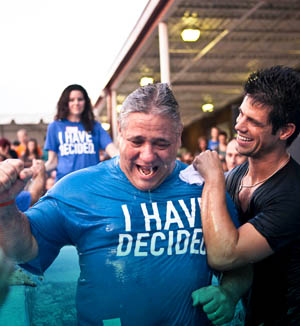
baptism manJacob watched them wade in and watched them wade out and he thought about what this beautiful ritual meant. The water of these springs was not magical, but they were powerfully symbolic and it evoked for Jacob the many images of water throughout the Scriptures – The waters of creation, the great flood, the parting of the Red Sea, the waters used in ritual cleansing. It reminded him of God’s promises spoken by the prophet Ezekiel: “I will sprinkle clean water on you, and you will be clean; I will cleanse you from all your impurities and from all your idols. I will give you a new heart and put a new spirit in you; I will remove from you your heart of stone and give you a heart of flesh. And I will put my Spirit in you and move you to follow my decrees and be careful to keep my laws. Then you will live in the land I gave your ancestors; you will be my people, and I will be your God.” (Ezekiel 36:25-28). In this simple ritual, all of these promises and images were being embraced as being fulfilled, just as much as Jesus was being embraced as the Messiah.

As Jacob watched the crowd filing in to be baptised, waiting for his turn, he also noticed an interesting thing. Some waded into the pools with their young children in their arms. There were even some whole families with infants who came forward to be baptised. But Jacob noticed that others didn’t take their children. Jacob saw one man who had just come out of the pool after his baptism, go to his wife, take their baby from her arms and then she went in to be baptised.

This perplexed Jacob and made him wonder, when it came to his turn, what he should do. Should both he and his daughter be baptised together, signifying that Jesus was their Messiah and they would follow and love him as they had followed and loved Yahweh? Responding to Jesus as the Messiah seemed to him the most natural thing for a Jew. If only he was baptised, would that mean that his daughter and he were separated in a way that they had never been? Would it mean she was no longer a Jew? Or that he wasn’t?

But on the other hand, should he only be baptised, to signify that he had received the forgiveness and cleansing that the Messiah offered. He could tell God had moved his heart to respond and although he knew the call went out to his daughter as well, it was he who was consciously responding to it. If little Mariah was baptised, what would it mean? Would it be meaningless? Would it be a lie? Would it be offensive to Yahweh? Or would it be the right response for a Jewish family embracing the Messiah? In fact, would it be offensive to Yahweh if he did not baptise her?

His head was filled with questions and confusion. In his arms, Mariah began to cry. As Jacob calmed his daughter he thought to himself, “This is ridiculous! Today is a day of good news! Where has my joy gone? A moment ago I was in awe that Yahweh had fulfilled his promises and shown my family such kindness, and now, I am stressed about causing him offence?” Then he prayed this prayer, “O Lord, please forgive my lack of faith in your compassion. Some people are taking their children with them to be baptised and some people are not. I am not sure of your will. Help me make the right choice with joy in this great day.”

When Jacob opened his eyes, it was his turn to step into the pool.

And so, Jacob stepped forward his daughter in his arms…

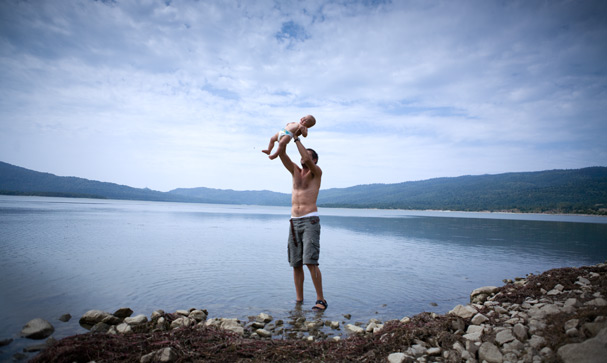
baby lake

I looked at Jacob as he waded through the water, towards the apostle James who stood in the middle of the deep pool. James was smiling and speaking to all those who came forward briefly before baptising them in the name of the Father and of the Son and of the Holy Spirit, just as Jesus had commanded. I was very curious to see what Jacob would do when he reached the front of the line, but suddenly, my view was blocked. At first I was frustrated, but I couldn’t stay that way. Stepping in front of me was a group of newly baptised converts, dripping wet and singing praises to the Messiah with laughter and tears and dancing and joy. “God has made Jesus both Lord and Messiah!” they cried, echoing the words Cephas had spoken to the crowd earlier. I looked around at the crowd that was full of others doing the same – praising God and declaring the gospel. All those who had accepted this message were baptised, and about three thousand were added to their number that day.

They devoted themselves to the apostles’ teaching and to fellowship, to the breaking of bread and to prayer. Everyone was filled with awe at the many wonders and signs performed by the apostles. All the believers were together and had everything in common. They sold property and possessions to give to anyone who had need. Every day they continued to meet together in the temple courts. They broke bread in their homes and ate together with glad and sincere hearts, praising God and enjoying the favor of all the people. And the Lord added to their number daily those who were being saved.

—————————–

This story was inspired by the record of the events on the Day of Pentecost,
which you can read for yourself in Acts 2.


(2648)

Share Button
June 16 2015

The ALIEN & JURASSIC Quadrilogy Parallels

alien park

With the fourth instalment to the Jurassic Park film franchise now in cinemas, I have been musing about its parallels to another great series – The Alien Quadrilogy. Now, as you start thinking about parallels between any two things, you will often see connections that don’t actually exist. I heartily guarantee that that is what I have done here. But hey, if you like movies like I do, and you don’t mind having fun comparing two awesome film series, then read on! (Also, it is worth noting that I may be discussing some key plot points or themes from all of the movies, so **MULTIPLE SPOILER ALERTS**)

THE “MONSTERS”

alien_vs_raptor_avr_by_vytorThe first, and simplest parallel is that they are both sort-of “monster” movies, and the beasts in each series are called that as well. In Aliens, the young girl named Newt says: “My mommy always said there were no monsters – no real ones – but there are.”, and in Jurassic Park, the young girl named Lex says: “Don’t let the monsters come over here.” The movies follow a lot of the standard monster movie plotlines, with scary things lurking behind every corner and people in peril trying to fight or flee from strange and deadly creatures. In both series, the threatening monsters are lizard-like, generally standing on two legs, with a long tail and a mouthful of sharp teeth. In a real stretch, trying to parallel these two monsters, I even recall that in Alien 3 one of the characters, Golic, calls the alien a “dragon” and there is a theory that dragons became part of our mythologies across the world in various cultures due to ancient interactions between humans and dinosaurs.

Having said that, the reason why I say they are “sort of” monster movies, is because in both series the young girls are actually wrong to call them by that name. As Dr Grant says in Jurassic Park, “They’re not monsters, Lex. They’re just animals.” In neither series are the creatures portrayed as mythical or magical. They are simply a different species (however physically superior) to humans – one being an alien and the other being a dinosaur. In regard to storytelling, this adds to the drama in a way that wouldn’t be as effective if they were actually “monsters”. You can imagine them being real and you can put yourself in the shoes of the humans. Fortunately though, because both aliens and dinosaurs are not part of our present lives on earth, their separation from our experience makes them more fantastical and open to more interpretation. This of course makes for great cinema, as both aliens and dinosaurs can be grounded in reality and fantasy at the same time.

THE THEMES

Man vs Nature
There are many common themes scattered throughout the Aliens and Jurassic quadrilogies. There is the whole “man vs nature” battle, exploring the folly of human beings to think they can control a powerful natural force, as represented by the aliens/dinosaurs. For the Jurassic series, this is the #1 main theme in Jurassic Park as Dr Ellie Sattler says, “The question is, how can you know anything about an extinct ecosystem? And therefore, how could you ever assume that you can control it?” It is also a small theme in The Lost World, where the character Sarah Harding thinks she can only “observe and document, not interact.” and Ian Malcolm points out that that is “a scientific impossibility. Heisenberg Uncertainty Principle. What you study, you change.” It’s not so much of a theme in Jurassic Park 3 (the weakest of the quadrilogy) but it definitely comes back as a big theme in Jurassic World, where there are characters trying to train dinosaurs, contain dinosaurs, genetically modify dinosaurs and use them for a variety of evil purposes. In the Aliens series, this theme is strongest in the second instalment, Aliens, with the arrogance of the marines thinking it will be easy to kill the aliens, but like the Jurassic series it definitely comes back in the fourth film, Alien: Resurrection, where there are characters trying to train aliens, contain aliens, genetically modify aliens and use them for a variety of evil purposes.

Genetics
Touching on “genetic modification”, I would actually say is its own theme worth discussing as it plays into both series in important ways. In the Aliens series, the alien takes on the genetic characteristics of the species that it bursts out of. This is not pointed out in the first two movies (though it is consistent with their humanoid arms and legs), but it is demonstrated in Alien 3 where the alien bursts out of a dog (or a bull in the far superior director’s cut version) and consequently runs around on all fours. This genetic modification means that the alien can improve upon and have an advantage over the species in its vicinity (if a ridiculously fast life cycle and acid for blood wasn’t enough). In the Jurassic series, the dinosaurs only exist because they have been genetically combined with the DNA of frogs. This genetic modification meant that the dinosaurs could spontaneously change gender to get past the “all dinosaurs are girls” limitation and ensuring their advantage over the humans. In both cases “life will find a way” for humans to be on the menu.

indominus-rex-environment-boxAs well as this, the writers of both series apparently run out of good ideas and in the fourth film of both series, the arrogant humans begin making genetically modified hybrid creatures. In Alien: Resurrection, Ripley (or the clone of Ripley) is a genetic hybrid of human and alien and there is also a big bad alien that is a genetic hybrid of human and alien as well. In Jurassic World, the big bad Indominus Rex is a genetic hybrid of T-Rex, Velociraptor, Carnotaurus, Giganotosaurus, Majungasaurus, Rugops, Cuttlefish and tree frog. And why did the scientists in both series use genetic modification in their respective fourth film? So they could turn their monster into a weapon to be used by the military. Yikes! If that’s not a parallel, I don’t know what is! Personally, I think both series were just trying to “increase the wow factor” and by the fourth movie in the franchise, they didn’t leave themselves many places to go other than creating weaponised hybrid monsters. It may have nicely fit in the overarching “men vs nature” theme, but as I’d have to agree with Chris Pratt’s character, Owen Grady when he says, “Probably not a good idea.”

Corporations
A big theme in both quadrilogies is the Corporate Machine. In the Aliens series, the corporation is Weyland industries – a company that travels to distant worlds and turns them into financially viable habitats. In the Jurassic series, the corporation is InGen – a company that travels to distant islands and turns them into financially viable theme parks. Both companies are greedy, idealistic, deceptive and interested primarily in how they might use the creature, rather than protect the people it might kill. In the first movies of both series, there is no one person who represents the coldness of the company – In Alien there is the robot, Ash (who is cold but not really human) and in Jurassic Park there is Dr John Hammond (who is human but not really cold). In the second movie of both franchise they really bring in perfectly slimy, corporate villain in the character Carter Burke (Aliens) and the character Peter Ludlow (The Lost World). Both of these villains are not personally violent or aggressive. They simply represent the interests of the corporation and in the second movie of both series, they share the storyline of being willing to put people in harms way in order to try to capture the creature and bring it back to the general population.

Women
Another theme in both quadrilogies is women and motherhood. This wasn’t going to be the way for Alien, as the iconic lead female character of Ellen Ripley was originally a man named Martin Roby in the first draft of the script, but the producer decided to change it to a woman, casting the then-unknown actress Sigorney Weaver in the role, and the rest is history.  Aliens, the second in the series, saw the return of Ripley as the kick-ass female heroine, but they added a new element, the little girl, Newt. The maternal themes are very strong as Ripley does everything to protect and rescue Newt from the other motherly figure in the film – the Queen Alien. The final battle involving Ripley, the Queen and Newt is fantastic and a great scene of feminine strength, containing the most awesome line of the entire quadrilogy… “Get away from her you BITCH!”. This motherhood theme is even more emphasised in the director’s cut of Aliens, where we have a scene that was cut from the theatrical release. In it, we find out that Ripley had a daughter back on earth, but sadly, as Ripley was in hypersleep for 57 years (between the first and second film), her daughter had died at the age of 66, only 2 years before Ripley was woken up. This grief of the lost of her child, was clearly supposed to be part of the maternal driving force behind her desire to look after Newt at all costs.

In the next two Alien films the motherhood theme continues with Ripley being impregnated with a Queen alien in Alien 3, which she discovered while getting an ultrasound (evoking a very maternal scene) and even when the alien bursts out of her in the final scene she holds it to her breast lovingly. In the fourth film, Alien: Resurrection the final scene shows the hybrid alien rejecting its real Alien mother and turning to Ripley believing she is actually her mother.

In the Jurassic quadrilogy, womanhood and maternal themes are also present. In almost all four films there are strong female characters: In Jurassic Park, there’s the strong, intelligent paleobotanist, Ellie Satler who doesn’t mind digging her hands into a giant pile of dino poop, and has the funny line, “Dinosaurs eat man. Woman inherits the earth.” Alongside her, there’s also the young, sassy character of Lex, who is a computer hacker and ends up saving the day by getting the security system back on line.  In The Lost World, we have Dr Sarah Harding, a rouge behavioural paleontologist who doesn’t worry about being around dinosaurs because, as she says, “I’ve worked around predators since I was 20 years old – Lions, jackals, hyenas.” There is also the annoying 12 year old character, Kelly Curtis, whose gymnastics scene is regarded as one of the most ridiculous in the entire quadrilogy, but she is also noted by fans as being the only person in the entire series who successfully kills a velociraptor, so she’s not at all a damsel in distress – just a terrible actor.

The Lost World, also has the theme of parenthood amongst the dinosaurs at its core. Dr Sarah Harding says that the reason why she is on the island is because she is “trying to change 100 years of entrenched dogma. Dinosaurs were characterised very early on as vicious lizards. There’s a great deal of resistance to the idea of them as nurturing parents. Robert Burke said that the T.rex was a rogue, who would abandon its young at the earliest opportunity… I can prove otherwise.” And the conclusion of the movie is that she does prove otherwise as shown by the very final scene of T-Rex couple caring for their young, along with other dinosaurs doing the same.

In Jurassic Park 3 & Jurassic World (the two Speilberg didn’t direct), the themes of motherhood are present, but sadly they drop the ball in terms of strong female characters. In fact, recently there Jurassic-world-1has been much discussion about Jurassic World’s character, Claire Dearing, and whether her character is in fact, a sexist caricature. After seeing one scene with her in it, Joss Whedon (writer/director of Marvel’s Avengers) tweeted that he was “wishing this clip wasn’t ’70s-era sexist. She’s a stiff, he’s a life-force – really? Still?” In Jurassic World, Claire is a hard working single woman who manages an enormous theme park, but instead of being portrayed as intelligent, strong and resourceful, they made her emotionally stagnate, incompetent, ignorant and generally a bad person for being too busy to look after her nephews. In a conversation with her sister over the phone she pines for the sad reality that she thinks she’ll never have children, and he sister quickly encourages her, “Don’t talk like that. It’ll happen for you. One day.” and a little later her sister begins crying and tells Claire that she’d understand if she were a mother. I’m not saying that the desire to be a mother isn’t a worthwhile theme. It just wasn’t done with any sophistication or with respect to single working women. If this weren’t enough, the velociraptors, which were untameable female killing machines in the first film, are in Jurassic World, able to be trained by Owen Grady because he is the “alpha” and in the end, Claire seems to get her wish of being a mum when Owen tames her as well, grabbing and kissing her in that painfully old fashioned mucho man way. The one glimmer of hope was when the comic relief character, Lowery Cruthers, swoops in to give his female coworker a similar kiss and she stops him and explains that she has a boyfriend. It was probably the funniest moment of the film and for me, it redeemed a little bit of the 2-dimensional gender stereotyping.

THE QUADRILOGY

Now you may think I’ve just been cherry-picking themes that match and ignoring the themes that are different between the two series… and you’d be absolutely right. There’s heaps of things I’ve ignored because they don’t line up. I make no claim that these films were deliberately trying to copy each other. I’ve just been noticing some things that do seem to match. I’ll finish this post with a summary of each film, side by side, so you can see the parallels that I have been noticing.

Film 1/4: “Alien” & “Jurassic Park”
A small group is requested to travel to a distant, isolated place where they discover an amazing species they never believed could exist. This lizard-like creature then begins killing everyone and they spend the rest of the movie hunting, running away, hiding and trying to escape to safety. This movie is the first of the series and it is a simple, classic and brilliantly directed movie. It is regarded by the fans as the best one of the quadrilogy.

Film 2/4: “Aliens” & “The Lost World”
One character from the first film is vowing never to return to the place where the lizard-like creatures were, but after they are told that other people have already gone there and they have lost contact with them, they are convinced to go there to try to rescue them. As a sequel, this film tries to be bigger and badder than the first. Naturally, therefore it contains more creatures, more colourful characters, more explosions and more dramatic action sequences. It has a slimy corporate sleaze-bag as the main villain who wants to take the creatures back to civilisation, but who in the end, gets eaten by the very creature he is wanting to exploit. This film also reveals that the creature is not just a dumb animal, but it also has a human-like parental desire to protect its young.

Film 3/4: “Alien 3” & “Jurassic Park 3”
Characters get accidentally stranded on an isolated place where they – and everyone else – is in danger of being eaten by one of the creatures. As this film is the third in the series, they creators felt the need to make it more interesting, and so the creature is different from the previous films and can do things that has not been seen before. Due to this straying from the formula, this third film was not received well and by many is regarded as the worst of the quadrilogy. They couldn’t even think of a clever title! They just got the name from the first film and put a number 3 on the end. Oh, yeah, one last thing… The first name of the main hero is “Ellen/Alan”.

Film 4/4: “Alien: Resurrection” & “Jurassic World”
Set many years after the last films, now the corporation is keeping many creatures in captivity where they are observed by humans behind the safety of glass walls. Everything is now quite commercial and driven by the greedy desires of the big company that believes that they own the creatures and can do with them what they wish. This arrogance leads the humans to experiment with genetically modified hybrid creatures, mixing various species together in order to try to make something completely unique. Their ultimate goal is to weaponise the hybrid creatures so they can be used by the military. Naturally, their arrogance leads to their own destruction as the creatures escape captivity and begin killing everyone in their path. A small group, led by the one person who has a special bond with the creatures, sets out to hunt down the creatures and save the day, but the final big confrontation actually happens between two of the creatures – one, the new genetically-modified hybrid creature and the other, an old-school female creature, harkening back to the earlier films. This last film draws together many of the themes of the previous three, but is not as well crafted as any of the others in my opinion.

Film 5?
There is talk of the series continuing, but we will see if anything eventuates.

So, there you have it. My musing about some of the parallels between two awesome quadrilogies.

If you can spot any more parallels, please put them in the comments below!


(3546)

Share Button
May 1 2015

The Death Penalty in Australia – a poem

crosses

THE DEATH PENALTY IN AUSTRALIA
a poem by Simon Camilleri

I weep as lives are taken

By a law so cold and strange.

I wonder why the government

Has not done more for change.

I shake my head at such a waste

Oh, what their lives could give!

Who knows what good they could have done

If they were free to live?

I hope one day we’ll value

Every life as having worth,

And learn that killing will not solve

The problems of the earth.

So do you #standformercy?

And will you stand with me?

And will you weep as lives are lost

Due to this tragedy?

Well, just before you answer,

Let me clear something please…

I’m not talking about the deaths

Of Aussies overseas.

Though stopping the death penalty

In Bali’s a good cause,

We have a worse injustice

Right at home upon our shores.

It’s Australia’s own death penalty.

Abortion is its name.

And every single year

100 thousand lives it claims.

I weep as lives are taken

By a law so cold and strange.

I wonder why the government

Has not done more for change.

I shake my head at such a waste

Oh, what their lives could give!

Who knows what good they could have done

If they were free to live?

I hope one day we’ll value

Every life as having worth,

And learn that killing will not solve

The problems of the earth.

So do you stand for mercy?

And will you stand with me?

And will you weep as lives are lost

Due to this tragedy?

(1749)

Share Button
April 21 2015

To ISIS with love


ISIS has said to Christians:

“We tell Christians everywhere that the Islamic State will spread, God willing. It will reach you even if you are in fortresses. Those who embrace Islam or jizya will be safe. But those who refuse… will have nothing from us but the edge of the sword. The men will be killed, the women and children enslaved, and the money seized. That is Allah and the prophet’s judgment.”

In return we say:

“We tell ISIS everywhere that the gospel of love and forgiveness will spread, God willing. It will reach you even if you are in fortresses. Those who embrace this gospel will be safe. But those who refuse will have nothing from us but our love. The men will be blessed with prayers for God’s mercy, as will the women and children, and we will spend the money necessary to send more missionaries to share this gospel with you. That is Yahweh and Jesus’ way.”


(1465)

Share Button
March 29 2015

Palm Sunday & the Unexpected King

donkey

Today is Palm Sunday. It’s a day we remember the entrance of Jesus into Jerusalem. It’s a relatively small and seemingly insignificant story in the Bible, so why do we stop to remember it? Well, have a read of the text from John’s gospel below and see what’s happening…

The next day the great crowd that had come for the festival heard that Jesus was on his way to Jerusalem. They took palm branches and went out to meet him, shouting, “Hosanna!”, “Blessed is he who comes in the name of the Lord!”, “Blessed is the king of Israel!”

Jesus found a young donkey and sat on it, as it is written:

“Do not be afraid, Daughter Zion; see, your king is coming, seated on a donkey’s colt.”

At first his disciples did not understand all this. Only after Jesus was glorified did they realize that these things had been written about him and that these things had been done to him.

(John 12:12-16)

So, a fairly simple story. Jesus is coming to Jerusalem, lots of people get all excited, calling him the king and shaking palm branches (hence, “Palm Sunday”), and Jesus gets on a donkey and rides into town. In verse 16 it says, “At first his disciples did not understand all this.”  Well, at first, you also might not understand all this either. Here are a few thoughts to help you see the significance of this event.

“Jesus was on his way to Jerusalem”

This line has two major points of significance. Firstly, from Jesus’ perspective. From other parts of the gospels we learn that Jesus had been planning to go to Jerusalem for a while and his purpose was to die. Jerusalem was (and is) the central city of all Judaism. It was where all the powerful leaders were. Jesus’ claim to be the prophesied king of God’s kingdom and the Son of God, was not that big a deal as long as he stayed to the little country towns in Israel. But if he went to Jerusalem that was like walking into the lion’s den. And Jesus knew it. So did his disciples. There is a key moment in Jesus’ ministry when he turns to head towards Jerusalem and his disciples are shocked and scared, but Jesus very clearly explains his reasoning for going. Read Mark 10:32-34…

They were on their way up to Jerusalem, with Jesus leading the way, and the disciples were astonished, while those who followed were afraid. Again he took the Twelve aside and told them what was going to happen to him. “We are going up to Jerusalem,” he said, “and the Son of Man will be delivered over to the chief priests and the teachers of the law. They will condemn him to death and will hand him over to the Gentiles, who will mock him and spit on him, flog him and kill him. Three days later he will rise.”

Jesus was going to Jerusalem in order to be captured. He was going there to die. He was going there to be resurrected. He was going there to bring about the first Easter.

Now, this was Jesus’ perspective. But the crowds who greeted Jesus had a different idea.

From their perspective, Jesus coming to Jerusalem was him finally putting his money where his mouth was. He had been talking about the kingdom of God and how he was the prophesied “Son of Man” from Daniel 7, and it was well known that he was a prophet and a miracle-worker and even called the Son of God. Jesus was the Messiah, the Christ, the promised king who would establish God’s kingdom, destroy the Roman Empire and allow the Jews to rule the world in prosperity and harmony with God forever! But until he came to Jerusalem, all his talk of being a king was just talk. It would be like if someone said, “I am the rightful Prime Minister of Australia!” but they always stayed in Coober Pedy and never went to Canberra.

From the people’s perspective, Jesus coming to Jerusalem was his triumphant entry where he was truly saying “I am king! And now I will take over!”

That’s why they were waving palm branches like it was a ticker tape parade and cheering battle cries: “Hosanna!”, “Blessed is he who comes in the name of the Lord!”, “Blessed is the king of Israel!” The word “Hosanna” means “Lord, save us” and it shows the crowd was basically quoting a couple of verses from Psalm 118…

“Lord, save us! Lord, grant us success! Blessed is he who comes in the name of the Lord. From the house of the Lord we bless you.” (Psalm 118:25-26)

They saw Jesus’ arrival as a king coming to assume his throne. Jesus saw his arrival as a dead man walking coming to be executed. Two very different perspectives.

“Jesus found a young donkey”

Why did Jesus enter Jerusalem on a young donkey? Was it because he was tired of walking and donkeys were easier to find than a horse and chariot? Well, the text doesn’t suggest that. In Matthew’s account of the story it gives even more detail about how they got the donkey. Jesus says to his disciples before they get to Jerusalem: Go to the village ahead of you, and at once you will find a donkey tied there, with her colt by her. Untie them and bring them to me. If anyone says anything to you, say that the Lord needs them, and he will send them right away.” 

It seems the donkey is something very, very deliberate for Jesus. So what is he trying to say? Well, both accounts of this story tell us that Jesus is using the donkey so that he would fulfil a prophecy made by the prophet Zechariah hundreds of years earlier.

In Zechariah 9:9-11, God spoke through the prophet to give a picture of what it would be like when his promised king would come to Zion (or Jerusalem).

“Rejoice greatly, Daughter Zion! Shout, Daughter Jerusalem!
See, your king comes to you, righteous and victorious,
lowly and riding on a donkey, on a colt, the foal of a donkey.
I will take away the chariots from Ephraim and the warhorses from Jerusalem, and the battle bow will be broken.
He will proclaim peace to the nations.
His rule will extend from sea to sea and from the River to the ends of the earth.
As for you, because of the blood of my covenant with you, I will free your prisoners from the waterless pit.”

The picture is definitely of a king. He is righteous and victorious. His rule will extend to the ends of the earth. And he will bring peace to all the nations of the world and freedom from those imprisoned. This is definitely a king. But it is an unexpected king.

His righteousness and victory doesn’t appear as strength or brute power. He comes lowly and riding on a young donkey. You can’t go to battle on a donkey! You can’t destroy the Roman Empire on a donkey! You can’t fight your way to the throne, destroying all your enemies in your way, and claim your rightful role as king of Jerusalem, if your warhorse is a donkey!

But that is the unexpected king. He takes away all chariots and warhorses and battle bows. He is the one who proclaims peace to the nations, not war.

Now, this act of weakness and lowliness, doesn’t mean he will not be victorious in establishing his rule. As the prophecy says, his rule will extend from seas to sea, and his lowliness does not jeopardise that one bit. In fact, his lowliness will be the very means by which his kingdom is established, peace is brought to the world and the prisoners are set free from the waterless pit.

You see that alluded to in verse 11 of the prophecy. It is because of the “blood of the covenant” that all this will happen. If you want to explore deeper as to what that phrase means, have a read of another blog I wrote on this topic HERE. To summarise though, it is pointing to the atoning sacrifice that was made on behalf of the people that established their relationship with God in the Old Testament (the story is found in Exodus 24:4-8).

For those that know the Easter story, they will remember that on the night before Jesus was crucified, he told his disciples that his own death would be the new “blood of the covenant”. Jesus saw his death as the ultimate atoning sacrifice that would free people from the pit, bring peace to the world and establish an everlasting relationship between God and all those who trusted in it.

That is why he comes lowly and riding on a donkey. That is why Jesus came to Jerusalem at all! He came to die. But not just to die. He came to die as an atoning sacrifice for people. Even his enemies. That’s why he doesn’t come on a warhorse. He doesn’t want to destroy his enemies. He wants to rescue them and embrace them into God’s kingdom. He wants to die on their behalf. He wants to save them.

The crowds were right.

So the crowds were right! They were right to praise Jesus as king – for that is who he is. They were right to say “Hosanna!” which means “Lord, save us” – for that is what he came to do. They were right to expect that he had come to Jerusalem to establish God’s kingdom and reconcile people to God. But they were wrong in how they expected he would do it.

The story finishes with the disciples being confused: “At first his disciples did not understand all this.” But then it tells us that, like us, they eventually understood what was going on: “Only after Jesus was glorified did they realize that these things had been written about him and that these things had been done to him.” When it says Jesus was “glorified” it is referring to Jesus’ death and resurrection (see John 12:23 & 17:1).

At first, the disciples were confused by what was going on. There was a juxtaposition. Jesus was the king, but he came to Jerusalem on a donkey. Jesus was supposed to be the Messiah, but he talked about dying. How did it all fit together? Well, after Jesus was glorified in his death and resurrection, then they realised that “these things had been written about him”. It was only after Easter that they remembered the prophesy of Zechariah and the puzzle pieces fit together.

Fortunately, we live in the time after Jesus has been glorified. And every Easter we can remember the great work on the cross he did to die for sinners like you and me.

For today, let us grab our palm branches and praise the king. Not having a false expectation of him establishing his rule through aggression and force, but seeing the mission from Jesus’ perspective, pointing to the cross as the great moment that reconciled God and people.

Let us remember that our king came lowly, riding on a donkey, and join in the cry, “Hosanna!

(2208)

Share Button
February 21 2015

Baptism & the Sinner’s Prayer

river-baptisms-112

As some of you may know, I have been reflecting on baptism for a while now, especially considering the issue about whether or not to baptise my daughter who is due in June. You can read my previous blog on why I am thinking about this issue HERE.

As I’ve been reading, researching and reflecting on the appropriateness of infant baptism, I have started with a simple question… What is baptism? When Jesus said to his followers who were mostly simple fishermen, “Go, make disciples and baptise them” (Matthew 28:19) they understood what he meant. So in my research, I didn’t want the super theological, highly complex, only can be understood if you have a Masters Degree of Divinity, understanding. I wanted the simple fisherman’s version. When they went out and said to someone, “Hey! You should become a disciple of Jesus and get baptised!”, when the other person said, “Why should I get baptised? What’s that about?”, I wanted to know how they would answer.

How would YOU answer?


BAPTISM THEN

One thing I’ve noticed is that for the first Christians, baptism was part and parcel of becoming a Christian. Right at the beginning of the Church’s mission to the world, after the first ever public evangelistic sermon, those that wanted to respond to Jesus asked the very simple question…

When the people heard this, they were cut to the heart and said to Peter and the other apostles, “Brothers, what shall we do?” Peter replied, “Repent and be baptised, every one of you, in the name of Jesus Christ for the forgiveness of your sins. And you will receive the gift of the Holy Spirit. The promise is for you and your children and for all who are far off—for all whom the Lord our God will call.” With many other words he warned them; and he pleaded with them, “Save yourselves from this corrupt generation.” Those who accepted his message were baptised, and about three thousand were added to their number that day. (Acts 2:37-41)

They asked, “What shall we do?”, and Peter answered “Repent and be baptised.”  And that’s what they did. It was fairly simple.

This is the pattern all the way through the Book of Acts as well:

When they believed Philip as he proclaimed the good news of the kingdom of God and the name of Jesus Christ, they were baptised, both men and women.
(Acts 8:12)

As they traveled along the road, they came to some water and the eunuch said, “Look, here is water. What can stand in the way of my being baptised?”
(Acts 8:36)

Immediately, something like scales fell from Saul’s eyes, and he could see again. He got up and was baptised.
(Acts 9:18)

The Lord opened her heart to respond to Paul’s message. When she and the members of her household were baptised, she invited us to her home.
(Acts 16:14-15)

The jailer called for lights, rushed in and fell trembling before Paul and Silas. He then brought them out and asked, “Sirs, what must I do to be saved?” They replied, “Believe in the Lord Jesus, and you will be saved—you and your household.” Then they spoke the word of the Lord to him and to all the others in his house. At that hour of the night the jailer took them and washed their wounds; then immediately he and all his household were baptised.
(Acts 16:29-33)

Crispus, the synagogue leader, and his entire household believed in the Lord; and many of the Corinthians who heard Paul believed and were baptised.
(Acts 18:8)

‘And now what are you waiting for? Get up, be baptised and wash your sins away, calling on his name.’
(Acts 22:16)

baptism-photoNow, it may seem (to those who know the different sides of the debate) that I am trying to put forward the case for credobaptism or “believer baptism”, but I’m not. I’m simply showing how, for the early Church, baptism was the way people responded to Jesus. What happened in their heart? God helped them believe the message. What happened in their mind? They repented from their sin and put their trust in Jesus. And what did they do with their body? They got baptised.

Baptism is so intimately connected with the response of believing and repenting that Paul recalls in his own story, how Ananais had said to him, “And now what are you waiting for? Get up, be baptised and wash your sins away, calling on his name.” (Acts 22:16) The act of baptism, the miracle of being forgiven (having your sins washed away) and the response of calling on Jesus’ name are all in the one package. This is why Peter in his first epistle, says that we are saved through the waters of baptism (1 Peter 3:21). This passage use to confuse me, but he goes on to describe baptism as “not the removal of dirt from the body but the pledge of a clear conscience toward God.” Baptism was the handshake that sealed the deal. It was the signature that signed the contract. It was the step over the line in the sand. It was the pledge of a clear conscience towards God.

Now, to be very clear, the Bible never says that baptism itself is what saves us or forgives us of sin. That would be to commit the mistake that the Catholic Church sadly has fallen into (I make mention of this in my previous blog on baptism). Even after Peter’s potentially confusing statement about being saved through baptism, he clarifies that it is actually “the resurrection of Jesus Christ” that saves you (1 Peter 3:21). It is Jesus that saves us, through his work not ours. We don’t even prompt Jesus to save us by our faith. As shown in many of the episodes in Acts, it is God who opens people’s heart to respond in faith. Our faith is a gift, so that our salvation is from God and by God from start to finish. As Paul writes so succinctly in Ephesians 2:8-9, “It is by grace you have been saved, through faith—and this faith is not from yourselves, it is the gift of God— not by works, so that no one can boast.”

So baptism doesn’t have any magical saving powers, but it is still tied very intimately to our response and to God’s salvation. They are all wrapped up together. Can you be saved without baptism? Of course! Think about the thief on the cross (Luke 23:38-43). But what should we do to respond to Jesus? Repent and be baptised. Simple as that.


BAPTISM TODAY

The sad thing I see today is that much of the church seems to have lost this simple approach to baptism. Both sides of the baptism debate have made it more complex than it needs to be. Pedobaptists churches can sometimes turn baptism into a highly complex, theological statement about the seal of God’s promises and the sign of the new covenant. I fear, they can sort of kill it with theology at times, like a joke that stops being funny after you have explained it in too much detail.

Credobaptists churches on the other hand, should be all for a simple “believe and be baptised” approach, but many of them can make it overcomplicated as well. Because they are committed to not baptising children from Christian homes unless they are really believers, they have developed systems for establishing this with supposed certainty. Many make people partake in several week-long baptism courses which you have to register for and in some churches they get you to wait until Easter when they do a mass baptism of lots of converts. In most churches, baptism is also connected with the idea of becoming a “member” of that particular church and so it begins to take on even more complexity. If you’re thinking about becoming baptised, you might be encouraged to wait until an appropriate date on which you can invite your friends and family along. It gets put off to an available Sunday service that isn’t too busy. And then there’s your testimony. Of course, you have to give a public testimony explaining how you came to trust in Jesus. And because of this, help in how to write a clear testimony is often worked into a baptism course, and people are given time to feel comfortable with standing up in front of a crowd and sharing their story. I know of Christians who have put off their baptism indefinitely, purely due to their fear of public speaking.

Where did it go so wrong? When did we lose the simplicity? When did baptism turn into such an event? In the New Testament, baptism is like a shotgun wedding. “Look, here is water. What can stand in the way of my being baptised?” the Ethiopian in Acts 8 says when he believes in Jesus. Nowadays, it can be more like a big ceremony, that looks like a wedding but the couple made their marriage vows a month or two earlier. People get baptised weeks, months or even decades after they repented and believed in Jesus. I think it’s weird. I think it’s sad. I think we’ve missed the point of baptism. It’s not just that it loses the excitement of the moment of conversion. It also loses the connection with the act of conversion itself. Remember, the passages from Acts? Conversion and baptism were part of the same package. You repented and were baptised. At the same time. On the same day.

This is maybe why we get so confused about what baptism is and how we should administer it. We’ve turned it into something with more complexity, more theology, more process and more red tape than it ever was meant to have. Now, I’m not saying that we should take it lightly or encourage people to do it willy nilly. But we don’t encourage people to repent and believe lightly either. Jesus tells us that we must count the cost of being a disciple (Luke 14:25-33) and he also warns us not to be one of those people who respond to the gospel with superficial enthusiasm, but who dump it all when times get tough (Matthew 13:20-21). Becoming a disciple of Jesus is huge. It is giving up your autonomy and your sin and your allegiance to anyone or anything other than Christ. It should not be done for foolish or selfish reasons. Like wedding vows, becoming a disciple of Jesus is a life-long commitment that should be entered into “reverently, discreetly, advisedly, soberly, and in the fear of God” (“The Form of Solemnization of Matrimony” from “The Book of Common Prayer”).

Having said this, the call to repent and believe in Jesus is an immediate call. As Paul writes in 2 Corinthians 6:2, “I tell you, now is the time of God’s favour, now is the day of salvation.” We are all called to respond to Jesus now. Not to wait or put it off. True, we must count the cost, but count the cost now. The warnings are generally not about responding to God too quickly, but too slowly. Like the man in the story Jesus told in Luke 12:16-21, who stored up his wealth and put off being rich towards God, and then one night God said to him, “You fool! This very night your life will be demanded from you.” We are told to respond now. And baptism, I think, was meant to be part of that response.


THE SINNER’S PRAYER

The role baptism had in the response of a brand new believer, has today been replaced in part by what’s known as the “Sinner’s Prayer”. The “Sinner’s Prayer” is a simple prayer that acknowledges our sin, asks Jesus for forgiveness and accepts Jesus as your Lord. There are no strict formulaic words to the “Sinner’s Prayer”, but at the end of every evangelistic tract you’ll find one. If you’ve ever been to a big evangelistic rally or event and they ask people to come to the front if they want to become a Christian, the prayer they get everyone to say is a version of the Sinner’s Prayer”. It is a decisive, verbal prayer of repentance and commitment. It is quite useful in evangelism because it has a beginning and it has an end, so you can say to people who have prayed it (if they truly meant it) that they are now saved and that they are now part of God’s family.

Sinners-Prayer-card_f_improf_629x495Some Christians are strongly against the idea of the “Sinner’s Prayer” (like Paul Washer who brings up some great points in this VIDEO). Mainly, their criticisms are about people’s confidence in their salvation being based on the prayer they said once, rather than the daily reliance on the work of Christ. I agree that the “Sinner’s Prayer” has a danger of being treated like a magical spell that once said with conviction, compels God to forgive you and make you born again. But I don’t think it has to be that way. When I repented and believed at age 16, it was through saying the “Sinner’s Prayer” around a kitchen table with some Christian friends who had shared the gospel with me. I can’t really remember all the words I said, but it was a clear moment to that reminded me that I had crossed the line and given my life to Jesus. Now I am under no illusion that it was the “Sinner’s Prayer” that saved me. It was Jesus who saved me. And like Lydia in Acts 16:14, I know that God was the one who opened my heart to accept the gospel, without any prompting from me. In fact, it was that opening of my heart that prompted me to want to say the “Sinner’s Prayer”.

Some people critique the “Sinner’s Prayer” because they say it is unbiblical. Nowhere in the bible do we see people reciting a particular prayer in their moment of coming to faith. When the men came to Peter and asked, “What must we do?”, Peter didn’t say, “Bow your head and repeat this prayer after me, line by line.” No, he said, “Repent and be baptised!” Now, although that is true, I do think there is biblical precedent for the idea of a prayer being the physical act that shows repentance. In Luke 18:9-14, Jesus tells a parable about a Tax Collector who beats his breast and says, ‘God, have mercy on me, a sinner’ and then goes home justified before God. Surely, that is as close to the “Sinner’s Prayer” as you can get. Also, in Romans 10:9-13, Paul writes: “If you declare with your mouth, “Jesus is Lord,” and believe in your heart that God raised him from the dead, you will be saved. For it is with your heart that you believe and are justified, and it is with your mouth that you profess your faith and are saved. As Scripture says, “Anyone who believes in him will never be put to shame.” For there is no difference between Jew and Gentile—the same Lord is Lord of all and richly blesses all who call on him, for, “Everyone who calls on the name of the Lord will be saved.” This “calling on the name of the Lord” has been maybe made a bit too formulaic in the “Sinner’s Prayer” but it seems their is definitely biblical for encouraging people to talk to God as part of the mark of their repentance.

The thing I think is unfortunate about the “Sinner’s Prayer” is that it seems to have replaced the role of baptism. Today, if you were asked by a friend you have shared the gospel with, “What must I do?”, would you answer with “repent and be baptised” or the “Sinner’s Prayer”? Part of the role of baptism I think was to give the convert a clear and decisive moment in time when they make the decision to become a disciple of Jesus. In the act of going into the water, they were identifying themself with Jesus and their acceptance of the gospel message. Today, we use the “Sinner’s Prayer” functionally in the same way, and baptism is left as this strange ritual that we do a long time afterwards, or for some, we never get around to doing at all!


WHERE TO FROM HERE?

I think for us to regain the purpose for baptism that is pictured in the Bible, I have a few thoughts:

  • Include baptism in our evangelistic call.
    • It may seem weird, but when we encourage our non-Christian friends and family to turn to Christ, I think we should encourage them to be baptised as part of that call. If we are worried that they would be turned off by such a tactile and public display of commitment, then maybe we don’t trust that God would be at work in their hearts. God is the one that opens people’s eyes and hearts to the beauty of the gospel. Maybe, when God does that, the idea of baptism wouldn’t be such a weird idea.
  • At evangelistic events and Youth Rallies, there should not be an alter call without baptisms.
    • altar-call1Either be ready to do baptisms when you want people to turn to Christ, or, probably more appropriately, don’t do alter calls. I asked one friend why he thought they thought they didn’t do baptisms at Youth Rally evangelistic events, he said it was because they expected that some kids were only responding due to the hype of the moment, and so they shouldn’t get baptised just in case it wasn’t genuine. If that is the case then why do an alter call? Why do the “Sinner’s Prayer”? What assurance can you give the new believer if you doubt that they truly are a new believer?
    • Some also think it’s simply impractical to call people to be baptised at such a large event, but that issue didn’t faze the early Church. When Peter told his hearers to “Repent and be baptised”, it goes on to say, “Those who accepted his message were baptised, and about three thousand were added to their number that day.” (Acts 2:41) Can we even fathom an evangelistic event where thousands of people respond to the gospel and do so by being baptised? I’m not saying if we don’t have baptisms, the converts aren’t real Christians. It’s just that when baptism is left out, I feel it loses its meaning and intended purpose.
  • Stop putting up so many barriers to baptism.
    • This is a controversial one, but hear me out. I’m not saying we shouldn’t care about who gets baptise and I even think we should refuse baptism to anyone who is doing it without “counting the cost” or wanting it for non-gospel reasons. But some churches have drowned the process of baptism with process and paperwork. There is no biblical reason why baptism has to be done at church. There is no biblical reason why it has to wait for Sunday. There is no biblical reason why it has to be done by an ordained minister.
    • I’m not saying that it’s wrong to wait to do it if you want to have family and friends present. There can be something very special about that. But it should be easy. It should be a natural response to Jesus, and pretty much, whoever wants to repent and be baptised should be allowed to. Think about the “Sinner’s Prayer”. If a friend told you they want to be saved and asked if you could pray with them, would you get them to do a “Sinner’s Prayer” course? Would they have to do it at a Sunday Service after they shared their testimony? Would you call the minister to do it for you? I really hope not! Sure you might ask them some “counting the cost” type questions to make sure they understood what it meant, but once you were fairly convinced that their desire to respond to the gospel was genuine, you would probably pray with them there and then! I think we should do baptism in the same way. Like the enthusiastic Ethiopian in Acts 8:36, we should encourage people to say, “Look, here is water. What can stand in the way of my being baptised?”
  • Get baptised!
    • This last point is for those Christians who have never been baptised. Get baptised! There are only two rituals that Jesus commands Christians to do – partaking in the Breaking of Bread and baptism. If you have never gotten around to getting baptised, go and get it done. Speak to you minister today, talk to a Christian friend. It doesn’t have to be a big deal. You can do it at church, or at the beach, or in a lake, or in your bathtub! It is sad that it is so far removed from your initial act of repentance and conversion, but the truth of the symbolic act is still as true today as it would have been if you had done it then. Getting baptised is a wonderful physical response to Jesus, and it is something that he commands, so doing it shows everyone your submission to and love for the Lord.


BAPTISM & CHRISTIAN KIDS

Now, all this talk about baptism being part and parcel with our response to Jesus, doesn’t necessarily answer the question about what Christian parents should do with their kids. A credobaptist may have read this blog and be saying, “It’s obvious! The call is to repent and then get baptised! Not to baptise and then hope they repent!” But I don’t think it’s that easy.

Child-with-Bible1As I have already mentioned, many credobaptist churches turn the process of baptism into a convoluted series of hoops that you have to jump through to prove that you are really truly genuine in your repentance. But the child born into a Christian family has a unique experience. They are not being called to convert, they are not being called to repent. They are (hopefully) being brought up with the truths of the gospel. They don’t come to respond to Jesus. They’ve been taught to respond to Jesus right from the beginning. Ideally, they have grown up knowing and believing the gospel and relating to Jesus as their Lord and God as their Heavenly Father.

The question remains, if this is their experience and they have no conversion “moment”, then when should they be baptised? Some credobaptists might argue that kids should be encouraged to get to a time when they “own” their faith and publicly profess themselves to be a Christian, and that that is the appropriate time for them to be baptised, but I don’t see any clear biblical basis for that as much as I don’t see any clear biblical example of infant baptism. The biblical model is that, for first time believers, they should repent and be baptised. For those that are brought up in a family that has already repented, there really is no clear biblical model. I have questions and concerns about infant baptism, but I think I have more of a problem with the uniquely credobaptist “ownership of faith” baptism.

This blog isn’t my final thought on baptism. In fact, it is really just the starting point. Repentance and baptism are supposed to go hand in hand. That I am clear on. Maybe I should ditch the terms “pedobaptist” and “credobaptist” and call myself “repentobaptist”. In any case, I will continue thinking about how this starting point relates to what I should do with my daughter that is due in June. Getting this initial understanding about the place of baptism is for now, enough for me to chew on.

(5330)

Share Button
February 17 2015

QUANTUM – a word game

Quantum

One day, back in High School, someone (probably my best friend Daniel) explained Quantum Physics to me with the idea that everything is connected to everything else. Now, I have no idea about Quantum Physics, but from that basic idea I developed my own little word game, which I called “Quantum”. Back in High School I really liked word games. I was particularly into the game called “Word Morph” where you have to get from one word to another by just changing one letter at a time (if you’ve never heard of this game, check it here).  Quantum is similar to Word Morph, in that you have a starting word and you have to try to get to a finishing word, but it is different in that you use conceptual links to change the words, rather than simply changing letters. It is also different in that it is not a solo game. It can be played with as many people as you like, but it best works with two people. This creates the most fun and challenging part of the game as you each compete to link to your word without knowing what the other person’s word is.

I have made many games over the years (Mega Church, Treasure Island, Royal Rescue, Please Finalise Your Purchases, Back Story, Nukes Spies & Propaganda, Paparazzi, Whoever Has the Four of Clubs Wins). Some of these have worked well and some of these have failed miserably. Quantum is definitely a game that has worked. Even today, over 20 years after inventing the game, I still play it quite often with my wife when we go on road trips or are killing time waiting for something. I thought I’d write up the rules here so that you can enjoy it too.


HOW TO PLAY “QUANTUM”

AIM:
The aim of the game is to be the first player to create a legitimate link to your winning word.

THE BASIC IDEA:
All players think of (or are secretly given) a word that they will try to get to. This is their winning word. A starting word is chosen and then players take turns saying words that link to the previous word. So player 1 says a word that links to the starting word, and then player 2 says a word that links to the word that player 1 just said. Each player is trying to pull the game towards their winning word, but neither player knows which word their opponent is trying to get to. Thus the game involves using multiple tactics to both get to your word and avoid the other player guessing what you word is.

HOW TO MAKE A LEGITIMATE LINK:
In Quantum, words are linked conceptually, meaning the linking word must have some understood relationship to the previous word. Common relationships between words may be things like:

  • They are commonly together in use or just in how people know of them (eg. “bacon” – “eggs”)
  • They are similar (eg. “cry” – “weep”)
  • They are opposites (eg. “hot” – “cold”)
  • They go from general to specific (eg. “job” – “accountant””)
  • They go from specific to general (eg. “cow” – “animal”)
  • They have some other relationship that is understood (eg. “vampire” – “scary”, “ninja” – “Japan”, “beans” – “flatulence”, etc.)

If you suggest a word that is not a good enough link, the other player may contest its legitimacy. For example, if after the other player said “fish” you tried to link it with the word “Christmas” because you always have fish at Christmas with your family, the other player could dispute it. At which point, you can either try to convince them of its connection, or you can more productively, just suggest another word.

No matter how lame the connection is though, the other player has the option of accepting it and playing on. They would do this naturally because it served their efforts to reach their own word. For example, if your opponent’s winning word was “Holiday” they may be very happy with your offer of “fish / Christmas”, as it will allow them to say “Christmas / “Holiday” and go on to win the game.

GAMEPLAY EXAMPLE:
This is how a game may play out…

  • Player 1 and 2 each secretly think of a word. P1 chooses “tree” and P2 chooses “snow”. They do not tell each other what their word is.
  • One of the players (let’s say, P1) chooses a starting word. To be fair, they try to choose something that is not an easy link to their own word. They decide the starting word is “fish”.
  • The player who didn’t choose the starting word (P2), then begins the game. They firstly say the word they must link to and then they say a linking word. They say, “Fish – Water”. They choose the word “water” hoping that it may eventually lead to allowing them to link to their winning word, “snow”.
  • P1 accepts the link by playing on. The new word they must link to is “water”, and so they say, “Water – Nature”, hoping this will lead to something to do with their winning word, “tree”.
  • At this point P2 contemplates going straight from “nature” to “snow” as snow is a part of nature, but they worry this might be seen as not a strong enough link and they don’t want to give away what their word is. Remember, they would only win the game if the other player accepts their linking word by playing on. They decide to go with something half way. So they say, “Nature – Weather”.
  • P1 continues with “Weather – Wind”, thinking that may somehow connect with the wind blowing through the leaves or something.
  • P2 then says “Wind – Blizzard”, trying to get it back to snow.
  • P1 is at this point wondering how on earth they might get from “blizzard” all the way to their winning word, “tree”. They muse to themselves, “I reckon I might be able to get from blizzard to Christmas, with the whole white Christmas cliche and Santa in the North Pole. And if I can link to a Christmas tree I could get to my winning word.” And so, without any idea what P2 winning word is, they say “Blizzard – Winter”.
  • P2 then puts on their best poker face and says, “Winter – Snow”.
  • P1 naturally accepts this and continues with “Snow – Snowman”, hoping this will push it towards Christmas.
  • P2 then smiles and declares, “My word was ‘Snow’!” And with that P2 wins the game.

The above description shows a lot of the thinking behind each word, but this is how the game would sound:

  • P1: The starting word is “fish”.
  • P2: Fish – Water
  • P1: Water – Nature
  • P2: Nature – Weather
  • P1: Weather – Wind
  • P2: Wind – Blizzard
  • P1: Hmm… Blizzard – Winter
  • P2: Winter – Snow
  • P1: Snow – Snowman
  • P2: My word was “snow”
  • P1: Wow. I suck at this game.

Now, this is a very short example. It can be this quick, but usually, the game goes a fair bit longer and involves various attempts by each player to get close to their word before someone finally gets it.

SUGGESTIONS FOR CHOOSING WORDS:
The more complex or unique the word, the harder it will be to get to, so effectively you can choose the level of difficulty of the game by the word that you choose. Choosing the word “car” may be fairly easy, whereas choosing the word “chlorophyll” may be really difficult.

Also, think about how many ways you might be able to get to your word. If your word is “nail-clipper” you may be quite limited in getting to your word, but if your word is “bill” you could get to your word through, “electricity” or “restaurant” or “name” or “money” or even, “duck”. Even though all these words get to “bill” in a different way, they are all legitimate links.

If on the other hand you want to choose a completely random word (or you find it hard to just think of a word off the top of your head) you can use cards from a game like Taboo or Pictionary, or if you have your smartphone, you can go to wordgenerator.net and get a random word from there.taboo-cards

In choosing the starting word, you can employ any of these techniques as well, but if you don’t have those games cards handy and you don’t want to look up a website, you could ask a friend who is not playing the game to think of the starting word. Alternatively, you could think of some creative way of choosing a starting word, like the first word that you see on a car’s bumper sticker or the word you put your finger on when you randomly open up a book off the shelf. The starting word can be unique or complex and it won’t be a problem, so have fun with it! If you just have one of the players choose a starting word (like in the gameplay example above), they must try to choose a word that has no obvious link to their winning word, and the other player starts the game, to try to make it as fair as possible.

WINNING THE GAME:
The game is won when your winning word is said and accepted as a legitimate link. This can happen by your opponent suggesting your winning word as a linking word, although this is quite rare. More commonly, you will say your winning word as a linking word. You only win if your opponent accepts it as a legitimate link, and they do this by linking another word to your winning word. Once this has happened, instead of taking your turn, you declare yourself to have won.

MISCELLANEOUS NOTES & RULES:

  • Trust
    • The game relies on trust. It is very easy to cheat or just pretend that you have won by saying, “That was my word!” at any stage. Play by the rules and don’t be a douche and you’ll have fun.
  • Numbers of players
    • The game works best with two players but can be played with more people with no change of the rules at all. The only problem is that the more people you play it with, the less your turn will influence it in your direction. Any more than three players and the game becomes more about luck than strategy.
  • Game length
    • The game will take as long as it takes. It could be as quick as 2 minutes (like in the gameplay example given above) or it could take a whole day (yes, I have actually played it for a whole day once when I was in High School). Generally though, once you get the hang of it, an average game goes for around 5-15 minutes, which makes it great for a road trip, as you might get in a few games by the time you reach your destination.
  • Sounding the same but different.
    • In Quantum, with every link the meaning of the word could change. For example, if P1 said “Vacation – Break”, P2 could say “Break – Destroy”, even though the meaning of “break” was different for both players.
    • This is even allowed if the spelling of the word is different, but it sounds the same. For example, if P1 said “Vacation – Break”, P2 could legitimately say “Brake – Accelerator”. Even though “break” and “brake” are spelt differently, in this verbal game, the change of the word’s meaning is allowed as they sound exactly the same.
    • This does not apply if the word sounds similar, but not exactly the same. For example, P2 could NOT say “Brick – Wall” just because “break” and “brick” sound similar.
  • No repeats
    • You may not repeat a word that has been accepted in the game. This would create an annoying loop in the game. If a word was offered but then rejected as an illegitimate link, it could be used at a later stage as long as the link was legitimate.
  • Random direction strategy
    • There are many strategies you may discover while playing Quantum. Primarily, you must think of what words you need to get your opponent to say so that you could possibly link to your winning word, and you have to think of creative ways to push the game in your favour. But there is also something else you are trying to do at the same time – namely, prevent the other player from reaching their winning word.
    • If you sense your opponent is getting close to reaching their word, feel free to throw the game in a completely random direction. You can do this by employing the rules mentioned above about linking words that have a completely different meaning to the word offered by your opponent. Changing the topic of the game from “Vacation – Break” to “Break – Destroy” may totally throw off your opponent’s strategy and open up new opportunities for you to get the upper hand. Basically, the point to remember is, you can say a word for a strategic reason to work towards your word, or to prevent your opponent from reaching their word, or for no reason at all. As long as the link is legitimate, it is allowed.

So that’s it! Hope those rules made sense. Try it with a friend and tell me what you think!

In fact, if you record a game of you playing it with a friend and send me the YouTube link, not only will I post it on this blog (if you want me to) but I’ll also let you know the EXPANDED RULES for Master Quantum players!

Have fun playing and I’ll leave you with a video of me and my very generous wife playing a couple of games, so you can see it in action!
(Sorry, the sound and video goes out of sync after a while. Cat wants a rematch to do the video again, so stay tuned!)

(2144)

Share Button
Category: Game, Life | LEAVE A COMMENT
February 2 2015

One More Year – a poem

Simon 37


ONE MORE YEAR

a poem by Simon Camilleri on his 37th birthday


Today I turn 37
One more year closer to heaven
One more year further from birth
One more year of life on earth

One more year to live this life
One more year to love my wife
One more year to raise my baby
Four more months to get sleep… maybe

One more year to serve and bless
To write the scripts for GSF
To direct a great carols event
To help guys fight the elephant

One more year to know God’s grace
To grow in love and hope and faith
To each day live closer to Christ
And daily thank him for this life

I’m 37 for one more year
Yikes… 40 is now feeling near

(1608)

Share Button
January 3 2015

Why worry about baptism?

WHY WORRY

Lately, I have been thinking lots about baptism. I am talking to people, posting thoughts on facebook, listening to talks and reading a really helpful book called, “Baptism: Three Views“. My aim is to reach a biblically faithful understanding of baptism and come to some conclusion as to which “camp” I sit in. There are many different understandings of baptism and people have debated it for centuries, but I am only considering three basic views – “pedo-baptism” (the idea that it’s appropriate to baptise children of Christian parents), “credo-baptism” (the idea that only professing Christians should be baptised) and “inbetweedo-baptism” (not a real term, but represents the view that either position is ok and there does not need to be uniformity between Christians on the issue).

But as the title of this blog asks… why worry about baptism? Why go to such lengths to think through an issue that may not be resolvable and is definitely not core to the gospel? Well, firstly I do want to acknowledge that I do think this is not a core gospel issue. Baptism is not necessary for salvation, a point that is most clearly shown by the story in Acts 10:43-48 where people respond to the call to believe in Jesus for forgiveness, are born again and given the Holy Spirit, and after all that are baptised. Only Jesus saves us and he does so when we put our faith in him, which is why Paul says in Ephesians 2:8-9, “It is by grace you have been saved, through faith – and this is not from yourselves, it is the gift of God – not by works, so that no one can boast.” Baptism doesn’t save us, so why worry about it?

great_commissionWell, baptism might not be necessary for salvation, but it is connected with salvation. All the views of baptism that I respect (namely the three that I mentioned above) acknowledge that baptism is an important ritual that Jesus commanded his disciples to perform as they spread the message of the gospel and made disciples. The final words of Jesus recorded in Matthew’s gospel record this command: All authority in heaven and on earth has been given to me. Therefore go and make disciples of all nations, baptising them in the name of the Father and of the Son and of the Holy Spirit, and teaching them to obey everything I have commanded you. And surely I am with you always, to the very end of the age.” (Matthew 28:18-20) Any Christian that takes seriously Jesus’ authority and his command for us to make disciples and spread his teaching, has to engage with what he means when he commands us to “baptise”.

First and foremost, it must challenge all Christians to get baptised themselves. There may be much debate about whether or not we should baptise our kids, but if you are an un-baptised Christian, then the call and biblical expectation to get baptised is a no-brainer. I understand some Christians may want to think through exactly what it all means, or they may be unsure about the mode of baptism (dunk or pour), or they want to make the event something their friends and family can come to, but those concerns should not drag on too long. We should rather have the enthusiasm of the Ethiopian eunuch in Acts 8:36, who after comprehending the gospel, said, “Look, here is water. What can stand in the way of my being baptised?” To put it off indefinitely or to simply ignore it, is I think, dishonouring to the beautiful ritual that baptism is supposed to be. At best it is a sign of being ignorant of the importance Scripture puts on it, and at worst it is an act of willing disobedience to the clear command of Jesus. So, if you haven’t done it and you’re a follower of Jesus, then get your bathers and get on with it!


MY JOURNEY WITH BAPTISM

So baptism is important to think about for all Christians, but why am I particularly engaging with this issue now? Well, the answer is in the blog I wrote before this one. I have a baby on the way. And so, I feel I need to come to some conclusion as to whether or not God wants me to get my child baptised. One thing I have come to realise is, I can’t do nothing. I can’t sit on the fence indefinitely. Basically, if I think about it for 20 years and then decide I believe that the pedobaptist view is correct, it’s a bit too late. It’s like someone driving towards a cliff as they are asking themselves “To be or not to be”. Once they hit the cliff, they have decided “not to be” whether they are ready for it or not! In the end, I do think there is some merit to the case for pedobaptism and so I think I should consider it before my child is too old and I have accepted the “credobaptist” position by default!

Even though my child’s impending birthday does create a sense of urgency (if you can call 6 months “urgent”), even before I was married I was interested in understanding baptism. You see, I was brought up in a Catholic family and so was baptised as an infant myself. For most of my childhood I didn’t contemplate my own baptism, but it did effect the way I understood Christianity. I was always taught that my baptism was like my ticket into heaven, and because of it, I was a child of God.

Baptism.146174950_stdAs opposed to what I now know the bible teaches, the Catholic Church’s position is that God uses the actual act of baptism to save us. The Catholic Catechism teaches: Holy Baptism is the basis of the whole Christian life, the gateway to life in the Spirit and the door which gives access to the other sacraments. Through Baptism we are freed from sin and reborn as sons of God; we become members of Christ, are incorporated into the Church and made sharers in her mission: Baptism is the sacrament of regeneration through water in the word.” 

Due to this teaching, I always just presumed I had a relationship with God and so I did not engage with the message of the gospel or the call to put my trust in Jesus for my forgiveness. It wasn’t until I was in my teens that I started to question this idea. Despite being told I was right with God, I didn’t feel it. It didn’t ring true to my experience.

At aged 16, I finally heard the message that I could be freed from my sin and received this rebirth as a child of God, not through my baptism, but through trusting in Jesus’ death and resurrection. I heard this message through a pentecostal family, who were very much “credobaptists”. The daughter, who I was dating at the time, even told me how she accepted Jesus as her Lord and Saviour and was baptised at the young age of 5!

After becoming a Christian I developed a real disgust with the idea of infant baptism. After all, it was my infant baptism that lied to me that I was already right with God and prevented me from seeking the truth about the gospel. At least, that’s how I felt. I came to think that infant baptism was the primary thing wrong with the Catholic Church and was the cause of most of their problems. Also, I had such a wonderful example of “believer” baptism in this pentecostal family’s testimony and now, my own experience.

I would have happily remained a devout credobaptist if it wasn’t for the Christian Union. If you haven’t heard of them, they are a wonderful evangelical group that meets on University campuses around Australia, teaching, evangelising, training and mentoring students. It was through the Christian Union (or CU as we called it) that I really started to delve into studying the Bible. The pentecostal church I had started going to was loving and full of enthusiasm, but they were not good at bible teaching. It was the CU that helped me study the bible, write bible studies, ask questions, seek answers, engage in robust theological discussion and get a fuller and clearer understanding of the gospel.

The CU (and its parent organisation, AFES) is made up of lots of denominations, but clearly there was a dominance of Anglican and Presbyterian churches. It was through the CU that I started attending Bundoora Presbyterian Church (a church I have now been going to for around 14 years). It was also through the CU that I heard the crazy idea that some Christians who knew the gospel and studied the bible, also believed that you could baptise infants!

You can image how shocked I was. For nearly 5 years I had believed that infant baptism was the biggest poison to true Christianity. I was thoroughly convinced that no valid biblical argument could be made for pedobaptism, but, not wanting to be stubborn in my beliefs, I was willing to be swayed. I looked for a solid biblical article that would explain the position to me, and low and behold… I found one! I am very sad to report I can’t supply a copy of this article, but I can testify to it’s arguments being solid and biblically based. It didn’t completely convince me, but it did show me that there was more to this debate than just what I had experienced in my childhood and conversion.

fenceFrom that point on, I was pretty much “on the fence” on the issue. Over the years I have done some thinking and discussing on the issue, but nothing that would compel me to pick a side. I would hear one argument and find it robust and convincing, but then I would hear a valid rebuttle and a presentation of the opposing view that was also robust and convincing.

As I said earlier, with a child on the way I feel I should once again pick up this issue and see if I can come to any settled position. Although I am an active member in my local presbyterian church, I feel no specific loyalty to agree with its position on this matter. My minister, Neil Chambers, is wise and very biblical, keeping our church focussed on the core issues of the gospel and not forcing people to agree with the official presbyterian position on an issue is not clear in Scripture. He definitely is a pedobaptist, but he would not expect I would have to agree with that position in order to be a member or be involved in church ministry. His focus has always be that Christian parents raise their children to love Jesus, whether they baptise them or not.

So, here I am, still on the fence. After years of reading and discussing, I feel I am getting a good grasp on both sides of the debate. In fact, if you are fully convinced of either position, I reckon I could happily and passionately argue for the opposing view. This doesn’t help me in my goal to reach some conclusion myself, but it does give me a respect for both sides, a humility when it comes to these issues, and an acknowledgement that neither side is “clearly” wrong or wildly unbiblical.

Now, I haven’t actually gone into the arguments for either position in this blog. This is partly because I am still reading the book “Baptism: Three Views” and wanting to solidify my thoughts a bit more. I will hopefully write another blog down the track to reveal and explain which position I have decided upon, when (or if) I eventually reach a decision. I just thought I’d write this blog to explain a bit of my journey so far and why I find it personally very stimulating, engaging and interesting to think about the issue of baptism.

To aid my journey, please feel free to do the following, either in the comments on this blog, or in an email to me personally:

  1. Share your own journey and questions relating to this issue.
  2. Pass on any articles, sermons or thoughts that you find explain either position well.
  3. Catch up with me to ask your own questions or to discuss or debate the topic with me. I’d love that!


Please also pray for me. This issue may be complex and both sides may have valid arguments, but I do want to be faithful to Scripture and the commands of Jesus, in how I think about this issue. At the same time, I don’t want to give this issue more time than I should. As my brother Tony advised me, I believe with the first child your primary thought will be “I must not drop you” until you relax. Just enjoy those early days.’ Good counsel.

So, why worry about baptism? Well, I don’t plan to worry too much. But I am looking forward to the journey. 

In the meantime, if you want a laugh, have a read of a funny post I wrote on this topic last year…

10 alternatives to “credobaptism” & “paedobaptism”


(3097)

Share Button